

Pakistan and Tajikistan Agree on Roadmap to Boost Bilateral Trade to $200 Million
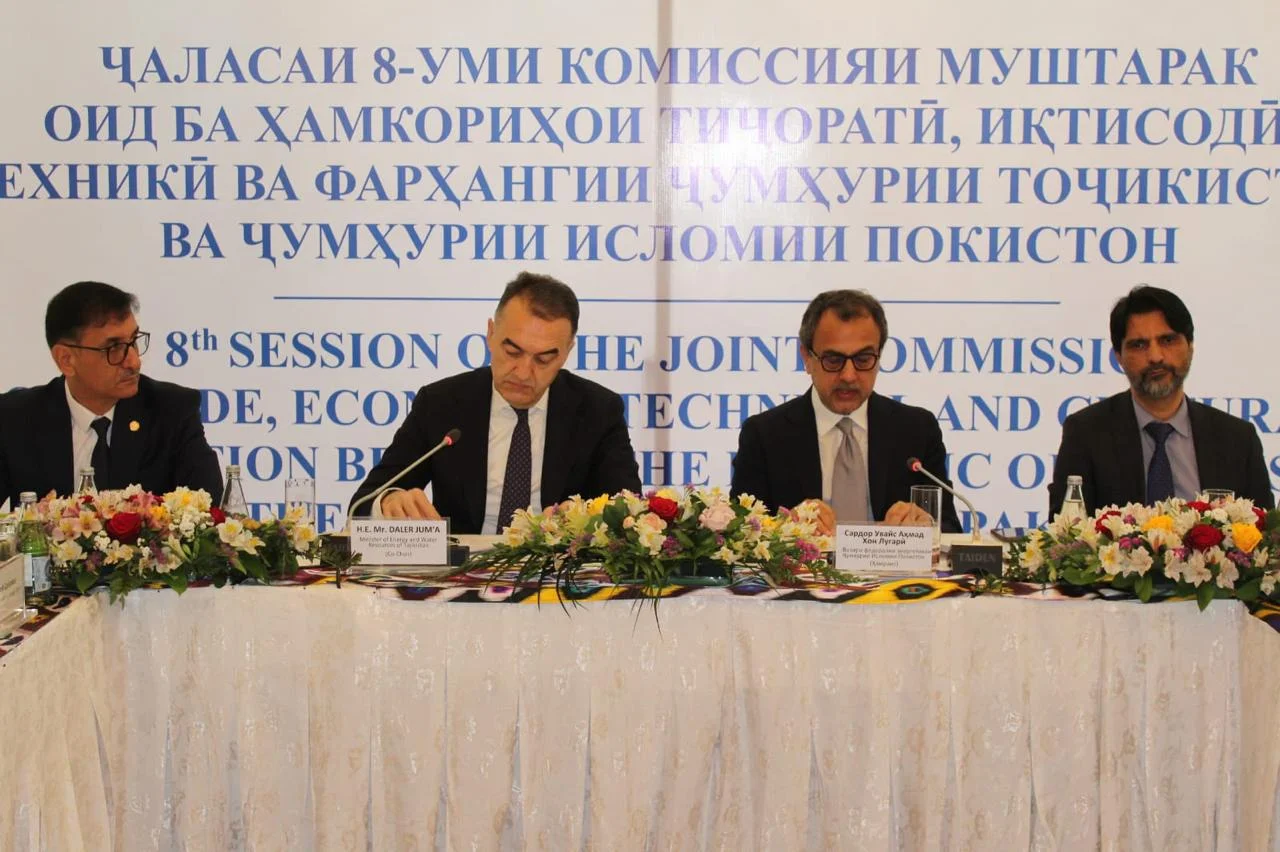
DUSHANBE: In a major move to strengthen regional connectivity and economic ties, Pakistan and Tajikistan successfully concluded the 8th session of the Joint Ministerial Commission held in the Tajik capital, Dushanbe. The high-level meeting focused on expanding bilateral trade, investment, energy cooperation, agriculture, and regional integration.
The Pakistani delegation was spearheaded by Federal Minister for Energy Sardar Awais Leghari, while the Tajik side was co-chaired by the Minister of Energy and Water Resources, Daler Juma Shofaqir.
Focus on CASA-1000 Progress and Energy Sector Investments
During the session, both nations finalized a strategic roadmap aimed at scaling up bilateral trade to USD 200 million. The two sides welcomed the promotion of Business-to-Business (B2B) meetings, enhanced online corporate networking, and the finalization of a Memorandum of Understanding (MoU) between the Trade Development Authority of Pakistan (TDAP) and the Export Agency of Tajikistan. Deliberations on a Preferential Trade Agreement (PTA) were also advanced.
Key Energy Takeaway: The commission lauded the current progress of the CASA-1000 power project, emphasizing the critical importance of its timely completion to address regional energy needs. Furthermore, Tajikistan expressed keen interest in offering lucrative investment opportunities for Pakistan Petroleum Limited (PPL) and OGDCL in its oil and gas sectors. Collaborative avenues in agriculture, education, science, and technology were also mutually agreed upon.
Minister Leghari Holds High-Level Talks with Tajik PM Qohir Rasulzoda
On the sidelines of the commission meeting, Federal Minister for Energy Sardar Awais Leghari called on the Prime Minister of Tajikistan, Qohir Rasulzoda, to convey the best wishes of Pakistan's leadership.
The meeting focused on expediting the CASA-1000 infrastructure, eliminating trade barriers, initiating direct flights between Islamabad/Lahore and Dushanbe, and streamlining visa facilitation to boost tourism and people-to-people exchanges.
8th Joint Ministerial Commission meeting concludes in Dushanbe; Federal Minister Awais Leghari leads Pakistani delegation
DUSHANBE: In a major move to strengthen regional connectivity and economic ties, Pakistan and Tajikistan successfully concluded the 8th session of the Joint Ministerial Commission held in the Tajik capital, Dushanbe. The high-level meeting focused on expanding bilateral trade, investment, energy cooperation, agriculture, and regional integration.
The Pakistani delegation was spearheaded by Federal Minister for Energy Sardar Awais Leghari, while the Tajik side was co-chaired by the Minister of Energy and Water Resources, Daler Juma Shofaqir.
Focus on CASA-1000 Progress and Energy Sector Investments
During the session, both nations finalized a strategic roadmap aimed at scaling up bilateral trade to USD 200 million. The two sides welcomed the promotion of Business-to-Business (B2B) meetings, enhanced online corporate networking, and the finalization of a Memorandum of Understanding (MoU) between the Trade Development Authority of Pakistan (TDAP) and the Export Agency of Tajikistan. Deliberations on a Preferential Trade Agreement (PTA) were also advanced.
Key Energy Takeaway: The commission lauded the current progress of the CASA-1000 power project, emphasizing the critical importance of its timely completion to address regional energy needs. Furthermore, Tajikistan expressed keen interest in offering lucrative investment opportunities for Pakistan Petroleum Limited (PPL) and OGDCL in its oil and gas sectors. Collaborative avenues in agriculture, education, science, and technology were also mutually agreed upon.
Minister Leghari Holds High-Level Talks with Tajik PM Qohir Rasulzoda
On the sidelines of the commission meeting, Federal Minister for Energy Sardar Awais Leghari called on the Prime Minister of Tajikistan, Qohir Rasulzoda, to convey the best wishes of Pakistan's leadership.
The meeting focused on expediting the CASA-1000 infrastructure, eliminating trade barriers, initiating direct flights between Islamabad/Lahore and Dushanbe, and streamlining visa facilitation to boost tourism and people-to-people exchanges.