

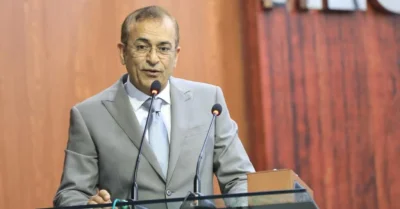
HEC Appoints Rector NUST Dr. Muhammad Zahid Latif as National Chair for Artificial Intelligence and Robotics
NUST to Lead Pakistan's Strategic Framework for AI, Automation, and Regional Technological Supremacy
ISLAMABAD — In a landmark development for Pakistan’s technological landscape, the Higher Education Commission (HEC) has officially entrusted the National University of Sciences and Technology (NUST) with the leadership of the country’s Artificial Intelligence (AI) and Robotics policy. Consequently, Rector NUST, Dr. Muhammad Zahid Latif, has been appointed as the National Chair for AI and Robotics.
The Higher Education Commission and NUST continue to play a pivotal role in advancing science, technology, qualitative research, and modern education across the country. This new appointment marks a structural shift toward centralizing advanced technological research and strategic policy formulation.
Shaping the National AI and Robotics Strategy
Operating from the NUST Islamabad campus, the newly established National Chair will collaborate closely with top-tier industry experts, policymakers, and academics to design a comprehensive national strategy.
Reacting to the appointment, Rector NUST Dr. Muhammad Zahid Latif characterized this responsibility as a profound expression of confidence in the university's academic caliber, research capabilities, and institutional integrity.
Addressing Policy Gaps and Structural Bottlenecks
The mandate of the National Chair extends beyond academic research into active governance and policy reformation. The Chair is specifically tasked with:
Identifying Vulnerabilities: Pinpointing structural weaknesses, administrative bottlenecks, and regulatory policy gaps within the current national framework.
Global Benchmarking: Reviewing international standards to draft recommendations for a robust, future-proof national framework.
Socio-Economic Integration: Creating viable pathways for integrating AI and automation into Pakistan's public and private sectors.
Vision for Regional Technological Leadership
The ultimate objective of this state-led initiative is to bridge the digital divide and elevate Pakistan into the ranks of the region's leading nations in artificial intelligence, advanced robotics, and modern automation. By establishing a centralized authority under NUST's leadership, Pakistan aims to accelerate high-tech manufacturing, secure digital infrastructure, and foster a knowledge-based economy capable of competing on the global stage.