

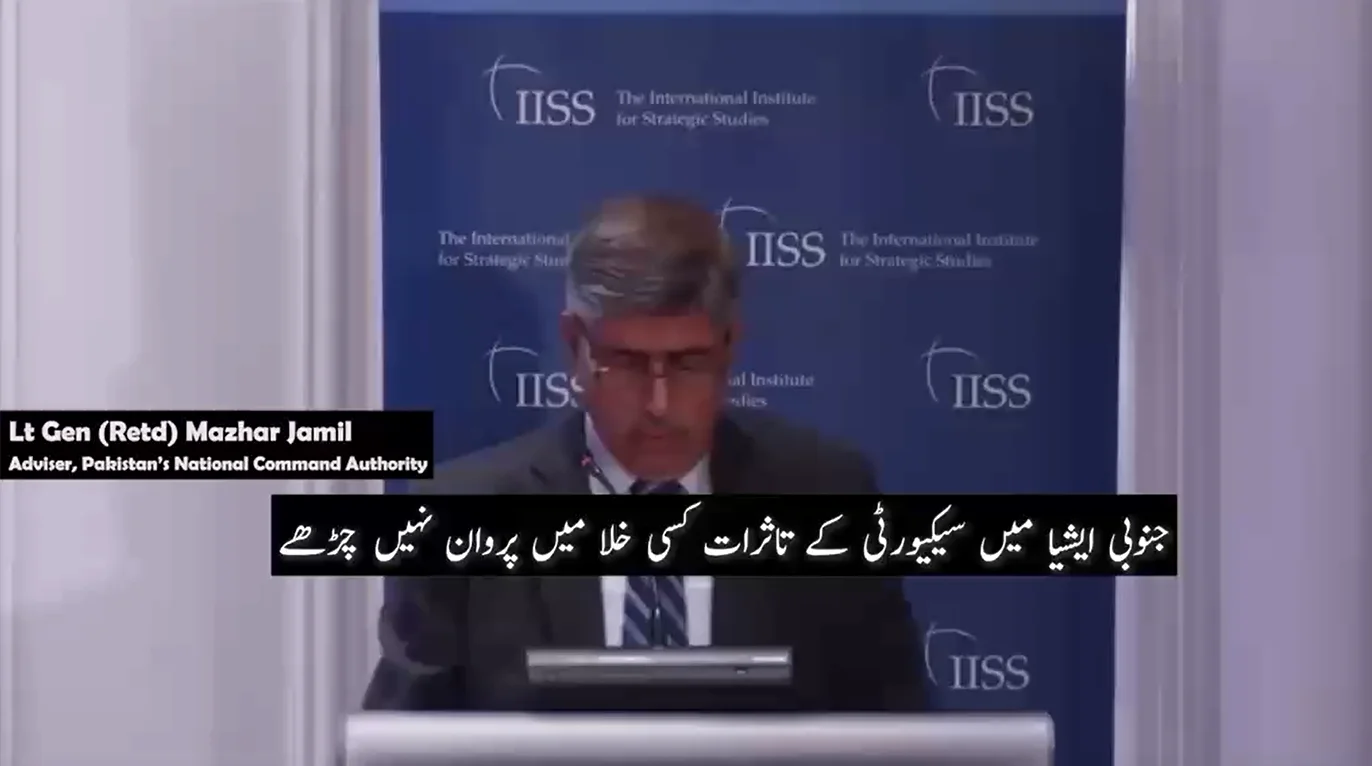
Indian Expansionism Is a Key Cause of Instability in South Asia: Mazhar Jamil
Speaking at a seminar organised by the International Institute for Strategic Studies in London, Lieutenant General (Retd.) Mazhar Jamil, an adviser to Pakistan’s National Command Authority, discussed the country’s domestic and regional security situation in detail. He described India’s expansionist ambitions and pursuit of regional dominance as the root causes of strategic instability in South Asia.
Lieutenant General (Retd.) Mazhar Jamil stated that India’s Hindutva-based politics was contributing to unrest in the region, while its aggressive military doctrine and rapid expansion of nuclear capabilities continued to threaten the strategic balance in South Asia. He expressed serious doubts about India’s longstanding claim that it would not use nuclear weapons first, warning that its missile programme and dual-capable weapons could trigger direct confrontation at any time.
Referring to past events, he said Indian aggression during the May 2025 crisis had brought the region to the brink of nuclear confrontation. However, Pakistan adopted a highly responsible approach after delivering an effective military response and ensured that the situation did not spiral out of control. He warned that Pakistan’s defence position was unequivocal: any act of aggression would come at an irreparable cost to the adversary. He described Pakistan’s nuclear capability and full-spectrum deterrence as fundamental guarantees of maintaining the regional balance.
He further stated that India was avoiding a just resolution of the Kashmir dispute and attempting to suppress the voices of the Kashmiri people through military power. He emphasised that a lasting solution to the Kashmir issue was possible only in accordance with United Nations Security Council resolutions. He added that lasting peace in South Asia required India to abandon military intransigence and pursue meaningful political dialogue.