

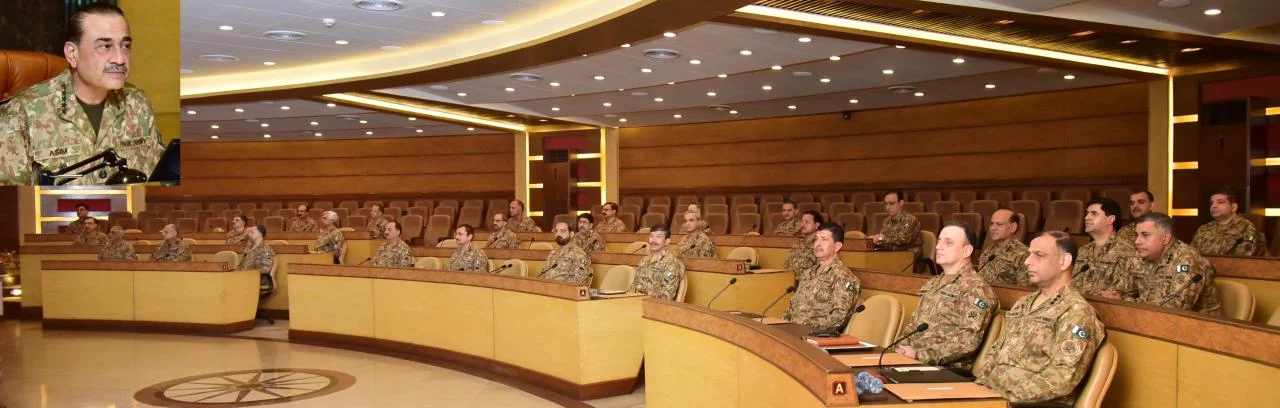
Corps Commanders Vow to Counter Hybrid Warfare and Strengthen National Security
Meeting Chaired by Field Marshal Asim Munir Reviews Security Situation, Approves Multi-Domain Transformation Plan
Rawalpindi (ISPR) ; The 276th Corps Commanders' Conference, chaired by Field Marshal Syed Asim Munir, Chief of Army Staff and Chief of Defence Forces, was held at General Headquarters (GHQ) to review Pakistan's internal and regional security situation, according to a statement issued by the Inter-Services Public Relations (ISPR).
The forum expressed concern over what it described as continued attacks and planning by India-backed militant groups allegedly operating from areas under the control of the Afghan Taliban administration.
The meeting began with prayers for members of the armed forces who lost their lives in the line of duty. Participants reaffirmed that the sacrifices of the country's martyrs remain the foundation of Pakistan's security, unity, and resilience.
Operation Ghazab-ul-Haq and Pakistan-Afghanistan Border Security
According to ISPR, the military leadership stated that lasting peace and stability in the region depend on preventing militant groups from using Afghan territory for attacks against Pakistan.
The statement said Pakistan expects the Afghan Taliban authorities to ensure that their territory is not used for hostile activities against Pakistan.
The conference reiterated that Pakistan has the legal right to defend its citizens against terrorism and stated that intelligence-based operations under Operation Ghazab-ul-Haq would continue against militant networks.
Participants also emphasized the need to strengthen governance in areas affected by militancy through effective administration and public service delivery.
Hybrid Warfare, Indus Waters Treaty, and Kashmir
The conference stated that after facing setbacks in conventional conflict, Pakistan's adversaries were allegedly attempting to spread instability through hybrid warfare and disinformation campaigns.
According to the ISPR statement, the military pledged to respond firmly to any externally supported attempts to create unrest in the country.
The forum also discussed recent Indian statements regarding the Indus Waters Treaty, stating that the guidance issued by Pakistan's National Security Committee (NSC) on 24 April 2025 remains the country's official policy framework. It added that the armed forces would support government decisions aimed at protecting Pakistan's water rights.
On Kashmir, the conference reiterated Pakistan's longstanding position that the dispute should be resolved in accordance with United Nations Security Council resolutions, enabling the people of Jammu and Kashmir to exercise their right to self-determination.
At the conclusion of the meeting, Field Marshal Asim Munir directed commanders to accelerate implementation of the military's Multi-Domain Transformation Plan to strengthen Pakistan's defence capabilities in response to evolving security challenges.
Key Highlights
- Counterterrorism: Intelligence-based operations under Operation Ghazab-ul-Haq will continue against militant networks, according to ISPR.
- Afghanistan: Pakistan called on the Afghan Taliban authorities to prevent their territory from being used by militant groups.
- Water Security: The conference reaffirmed Pakistan's position on the Indus Waters Treaty, referring to the NSC's policy guidance.
- Hybrid Warfare: The military pledged to counter disinformation campaigns and other forms of hybrid warfare.
- Military Modernization: Commanders were directed to accelerate implementation of the Multi-Domain Transformation Plan.