

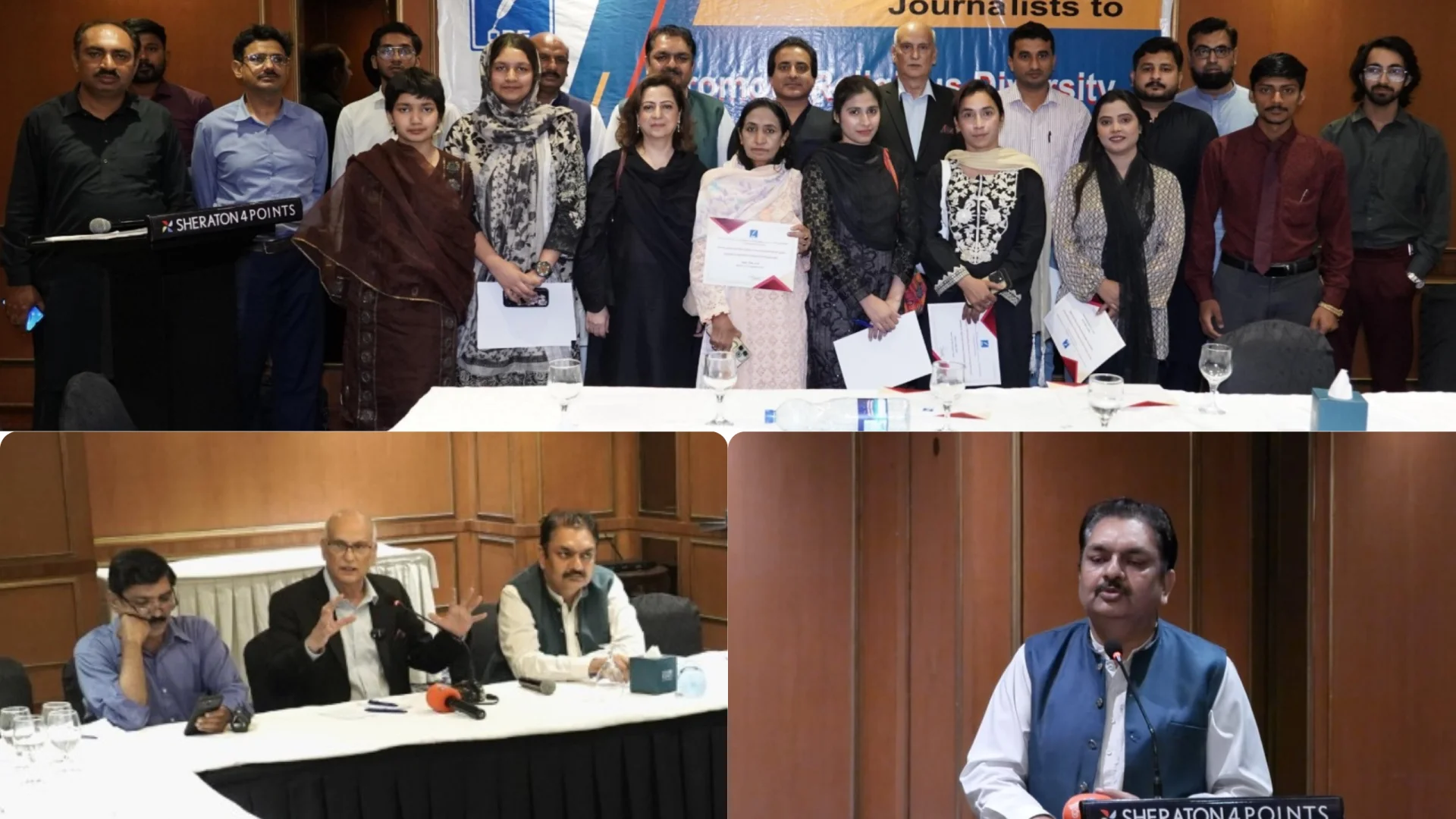
Mainstream Media’s Neglect of Balochistan Fuels Extremism, Responsible Journalism Needed: Experts Urge at Lahore Workshop
LAHORE – Mainstream national media is critically overlooking the social, cultural, and political transitions in Balochistan, failing to provide the balanced coverage necessary to counter extremism and build a cohesive national narrative. This critical assessment was voiced by leading journalists, security analysts, and academics during a specialized training workshop for working journalists held in Lahore.

Organized jointly by the Organization for Research and Education (Idara-e-Taleem-o-Tehqeeq) and the think tank Global Policy and Research Centre, the workshop focused heavily on countering hate speech, tackling fake news, and amplifying the marginalized voices of Balochistan to foster national cohesion.
Key Discussion Points
The Balochistan Blind Spot in Mainstream Media
Addressing the session, senior journalist and representative of the Global Policy and Research Centre, Muhammad Hanif Qamar, highlighted the severe disconnect between the national press and Pakistan's largest province.

"Regrettably, our national media routinely ignores the societal fabric of Balochistan. It remains largely unaware of—and indifferent to—the deep-rooted cultural, social, and civilizational shifts happening on the ground," Qamar stated.
He emphasized that journalists bear a professional and historic responsibility to comprehend the Balochistan issue through its complex historical, civilization-rich, and geo-political lenses, rather than relying on superficial reporting. The lecture sparked an intense Q&A session where working journalists debated structural barriers to covering the province effectively.
Formulating an Economic and Counter-Extremism Narrative
The workshop connected media coverage directly to regional stability and economic development:
Investment and Economic Projection: Prominent businessman and social reformer Manzoor Malik argued that attracting investment to Balochistan requires a dedicated, positive national media strategy. He noted that economic growth cannot happen in a communication vacuum.
The Threat of Fake News: Khawaja Naseer, President of the Punjab Assembly Press Gallery, warned that unchecked fake news and targeted misinformation campaigns significantly exacerbate regional alienation and threaten national security.

Broadening the National Discourse: Education, Health, and State Challenges
The training session also featured multi-disciplinary perspectives on state-building and civic responsibility:
Challenges to the Nation-State: Renowned scholar Dr. Ammar Khan Nasir delivered a lecture on the modern concept of nation-states, exploring how religious thought interacts with contemporary challenges facing diverse federations.
Socio-Educational Reforms: Eminent educationist Prof. Dr. Zarqa Bashir mapped out how strategic media partnerships can reform the education ecosystem.
Public Health Literacy: Dr. Ghulam Rahmani Jappa, a leading endocrinologist and media influencer, discussed the dual nature of digital media in public health, warning against misinformation regarding mental and physical healthcare.